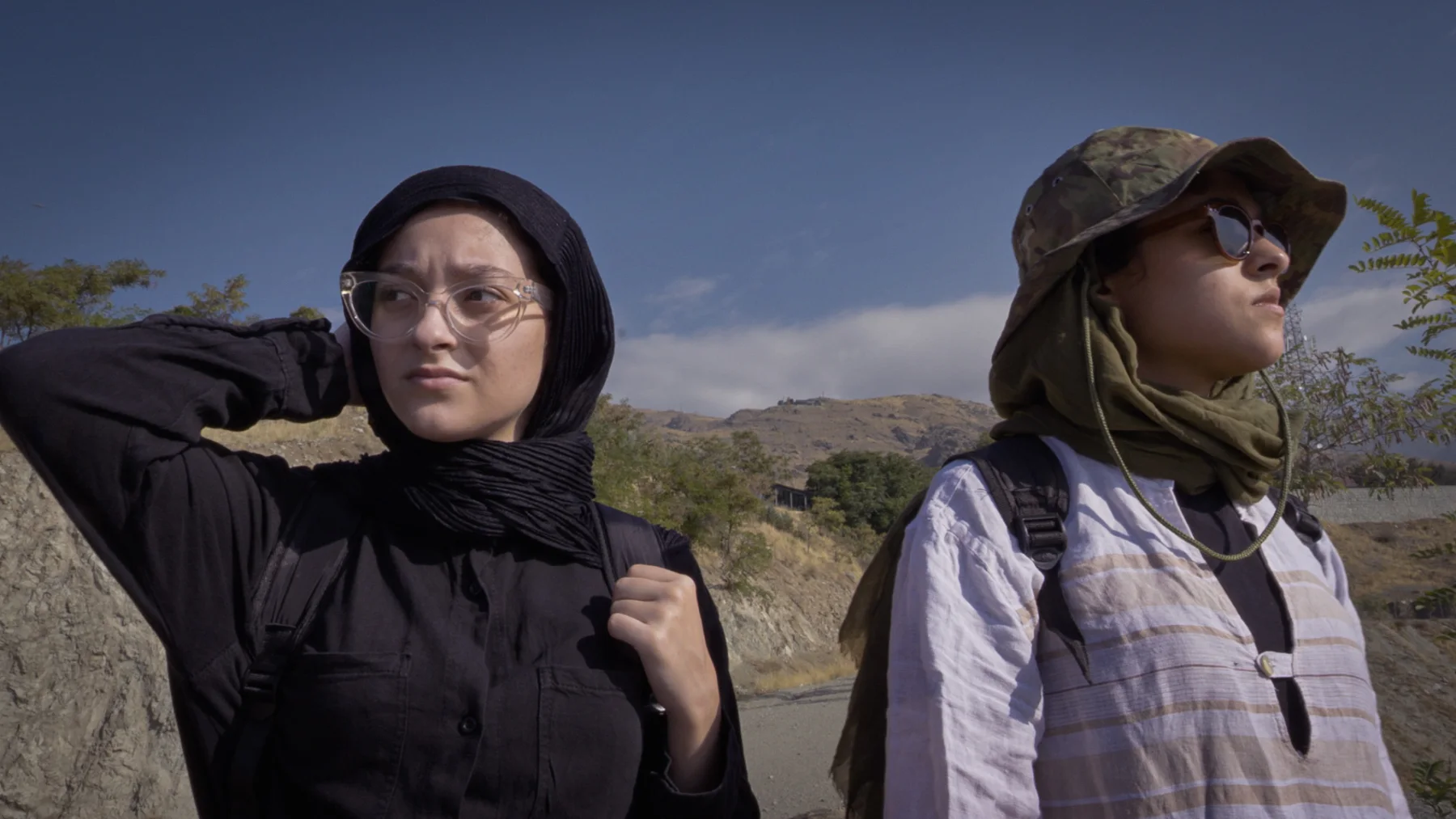
Some movies tell a story, others allow time to do its work, until the story itself comes knocking at History’s door.
Massoud Bakhshi’s All My Sisters belongs to this second family. The movie begins like a domestic album, with the deceptive tenderness of childhood images: gestures, faces, interiors, conversations, bodies still protected by the illusion that growing up simply means changing age.
Then, little by little, the years pass, Tehran changes, the girls become women and the documentary reveals its true substance: not merely the memory of a family but the inscription of private life within a political tragedy.
From 2007 to 2025, Bakhshi films three sisters in a loving family at the heart of an Iranian society crossed by traditions, injunctions, revolts, prohibitions and hopes. The method appears profoundly simple: to follow the passage from childhood to adulthood, to let faces transform, to let voices gain precision, to let questions become more dangerous.
Yet this simplicity is precisely what gives the film its power.
Nothing feels forced. Great History does not enter with a crash, it seeps into clothing, into silences, into the way one young woman looks at the camera, into the way another suddenly measures what she will have to face in order to be fully herself.
The film is moving because it never tries to manufacture emotion. It gathers it. It observes that ordinary and yet overwhelming miracle: three children become consciences. They are not born as symbols, they become so because the world around them forces them to understand, very early on, that their freedom is not an abstraction. It is negotiated through the body, in the street, within the family, before the law, under the gaze of others. This freedom is not a comfortable slogan. It is a risk.
This is where All My Sisters finds its deepest beauty. The film does not look at these young women as distant icons of Iranian resistance but as whole beings: contradictory, funny, discreet, lucid.
Their strength does not come from a heroic posture. It comes from an obstinacy to live. They laugh, remember, question, doubt, assert themselves. And within this continuity of modest gestures, something larger begins to emerge: the slow formation of a dignity.
The “Woman, Life, Freedom” movement inevitably haunts the film, not as a historical footnote but as a moral horizon. It gives a collective language to what the film has patiently watched being born in the intimate sphere: the refusal of erasure, the refusal of a diminished life, the refusal of a society that claims to love its daughters while keeping them under surveillance. Bakhshi films this contradiction with remarkable restraint. He does not turn his characters into arguments. He restores their complexity to them. It is precisely because they are never reduced to a political function that their presence becomes political.
One could say that All My Sisters is a movie about Iran. That would be true but insufficient. It is also a movie about the way cinema can rescue something from time before power attempts to confiscate it. To film these girls for eighteen years is to preserve the proof that they have grown, thought, desired, loved, dreamed. It is to oppose against the brutality of systems, a fragile and luminous archive. Where regimes often seek to simplify human beings, cinema restores their depth.
The current context makes the film even more painful. At a time when American and Israeli strikes against Iran, ordered within the framework of the war begun in 2026, revive the logic of blocs, humiliations and nationalist reflexes, All My Sisters reminds us of a truth that geopolitics too often forgets: peoples are not their leaders and women fighting for their freedom gain nothing by becoming collateral damage in the strategies of old men drunk on power. Military operations may claim to target a regime; they also risk crystallizing, among those who hope for another society, an anti-Western feeling that the ruling power will know how to exploit.
This is why the film angers as much as it moves.
Not because it is militant in a narrow sense but because it makes visible what international politics too often renders abstract. There is, in these faces, in these voices, in these sisters, a promise that nothing should be allowed to stain.
A promise of counter-history. A promise of 1979 in reverse: not a revolution confiscated by men, dogmas, and institutions, but a patient, feminine, daily, irreducible liberation.
Massoud Bakhshi has already shown, with A Respectable Family and Yalda, a Night for Forgiveness, his attention to the links between intimacy, morality, and society. With All My Sisters, his return to documentary takes on an almost testamentary form: he does not merely comment on Iran; he watches it grow in the eyes of these girls.
The gesture is all the stronger because it refuses grandiloquence.
What remains with us, finally, is not only the pain of a country. It is the light of these young women. A light without naïveté, without triumphant certainty, but stubborn. They do not ask for power. They ask for air. They ask for the possibility of living their beliefs, their desires, their contradictions, without seeing their sisters or their brothers in humanity repressed.
They do not want to dominate the world, they want to breathe within it.
Perhaps this is the greatest strength of All My Sisters: to make us feel that freedom is not a spectacular idea.
Sometimes it is a face lifting its head.
A voice that no longer lowers itself.
A sister looking at another sister and understanding that they are no longer alone.
In theaters in june the 3rd 2026