Grief in the Open Air
There are films that settle.
The New West is one that lingers.
From its opening moments, something slips away
not reality itself, but the way we are accustomed to grasp it.
Across the mineral vastness of the Badlands, Kate Beecroft composes less a narrative than a sensation: a space where gestures, silences, and glances seem to carry a density that precedes storytelling.
The film does not present itself as a story.
It offers itself as a presence.
What Remains of the Western
The title operates as a quiet manifesto.
This is not so much a “new” West as a West after the fact stripped of its heroic mythology, emptied of its narrative certainties. Horses remain, as does dust, but conquest has been replaced by something far more intimate: the slow, often invisible conquest of the self.
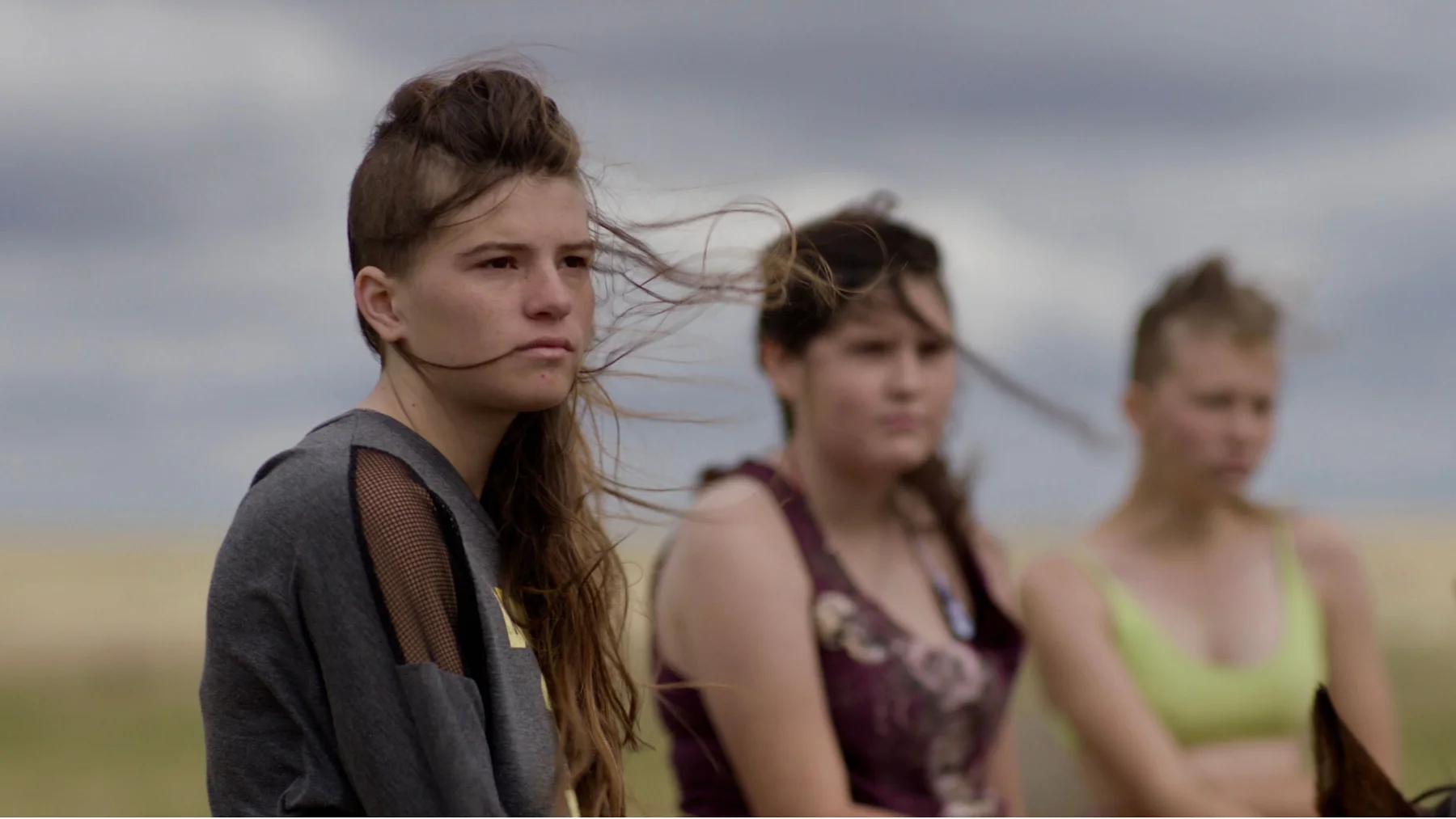
At its center, Tabatha moves without affectation. She does not perform a role; she inhabits the frame with an almost documentary intensity. Around her, teenage girls ride with a freedom that resists spectacle. They are not reenacting the western they are indifferent to it.
At times, one is reminded of Rodeo from Lola Quivoron , yet here any trace of stylization dissolves into something more elusive, more unstable.
Reality, Displaced
Very quickly, a question arises without ever finding resolution:
what, exactly, are we watching?
The film sustains a fertile ambiguity. Bodies, places, relationships bear the unmistakable imprint of lived experience, and yet something, almost imperceptibly, organizes, frames, and shifts it. Reality is not captured; it is rearticulated, extended into a form that neither fixes nor explains it.
This is neither documentary nor fiction in any conventional sense.
It exists in the space between where lives are replayed without being betrayed, where staging becomes a means of approaching a more diffuse, less declarative truth.
This uncertainty is never theoretical. It is felt.
In a gaze held too long. In a hesitation. In an emotion that seems to emerge before it can be named.
Even in fleeting TikTok fragments that punctuate the film’s texture.
Grief as Movement
At the heart of the film lies no central event, only an absence.
Grief runs through every frame without ever announcing itself. It resides in silences, in contained tensions, in the fragile bond between a mother and her daughter.
This relationship, rendered with quiet precision, resists dramatization. It unfolds in fragments, in distances, in restrained gestures. Love is never declared; it circulates—elsewhere, through other forms, through the shared language of horses.
One might think of The Piano, in its way of extending the female body into the landscape. But where Campion composed, Beecroft allows something rawer to surface an encounter with the untamed as a form of knowledge.
Listening to the World
The sound design by Sergio Diaz functions as a second writing.
The wind does not accompany the image, it opens it.
Hoofbeats do not mark action, they carve time.
As the film unfolds, sound begins to overtake narrative. It does not describe; it suggests a geography of Porshia’s inner world. It shifts, transforms, displaces.
What matters seems to pass through this zone where language falters.
Figures in Transformation
What unfolds here exceeds resilience.
These women do not overcome their trials. They move through them and in doing so, are altered. There is, in their gestures, a quiet mutation, a way of inhabiting the world differently after loss.
The film captures that fragile threshold where something shifts
not toward resolution, but toward another state of being.
A light, discreet yet persistent.
A Cinema of the Threshold
Presented at the Sundance Film Festival, The New West belongs to a rare lineage of films that do not seek to fit within categories, but to unsettle them.
It does not document.
It does not fictionalize.
It explores.
And in that exploration, it rediscovers something older than narrative itself: a way of seeing, of listening, of being in the world.
There are films we interpret.
And others that, more quietly, stay with us.
The New West belongs to the latter
a work that never imposes itself, yet gradually reshapes the way we perceive the inner landscapes of human experience.