
Entering a World Already in Motion
There is something quietly exhilarating about entering a film as one might jump onto a moving train,
off-balance, slightly disoriented, aware that something has already begun without us.
On the edge operates precisely in that space. It does not open so much as it unfolds mid-motion, as though its beginning had either already passed or never truly existed.
From its very first moments, the movie refuses to present its setting as a stable environment.
Instead, it immerses us in a space that must be experienced rather than understood, where the contours of reality remain elusive, constantly slipping away just as the gaze attempts to settle.
The closed psychiatric ward is not introduced, it is endured. Bodies circulate, voices emerge and recede, and no reassuring distance is offered to organize perception. The long takes are not merely stylistic; they anchor us in a continuity that resists fragmentation, forcing us to inhabit time rather than observe it.
Care as a Zone of Instability
What the film ultimately interrogates is not psychiatry as an institution, but the act of care itself, its ambiguity, its fragility, and its inherent permeability.
The relationship between Alexia and Mila does not unfold according to familiar emotional or narrative patterns.
Instead, it evolves within a grey zone, where empathy gradually transforms into commitment, and where that commitment begins to blur into projection.
Joëlle, the head nurse, embodies a form of disciplined restraint, insisting on the necessity of distance. Alexia, by contrast, moves forward exposed, as though understanding another person required a form of personal risk, perhaps even a surrender of boundaries.
The film never judges this movement. It observes it, patiently, tracing its subtle shifts and quiet intensifications.
A Cinema of Disorientation
The film’s formal rigor is inseparable from its emotional impact.
Its long takes create a temporal field without refuge, a continuity that denies the viewer any safe vantage point.
One is not allowed to step back; one must remain within the unfolding moment.
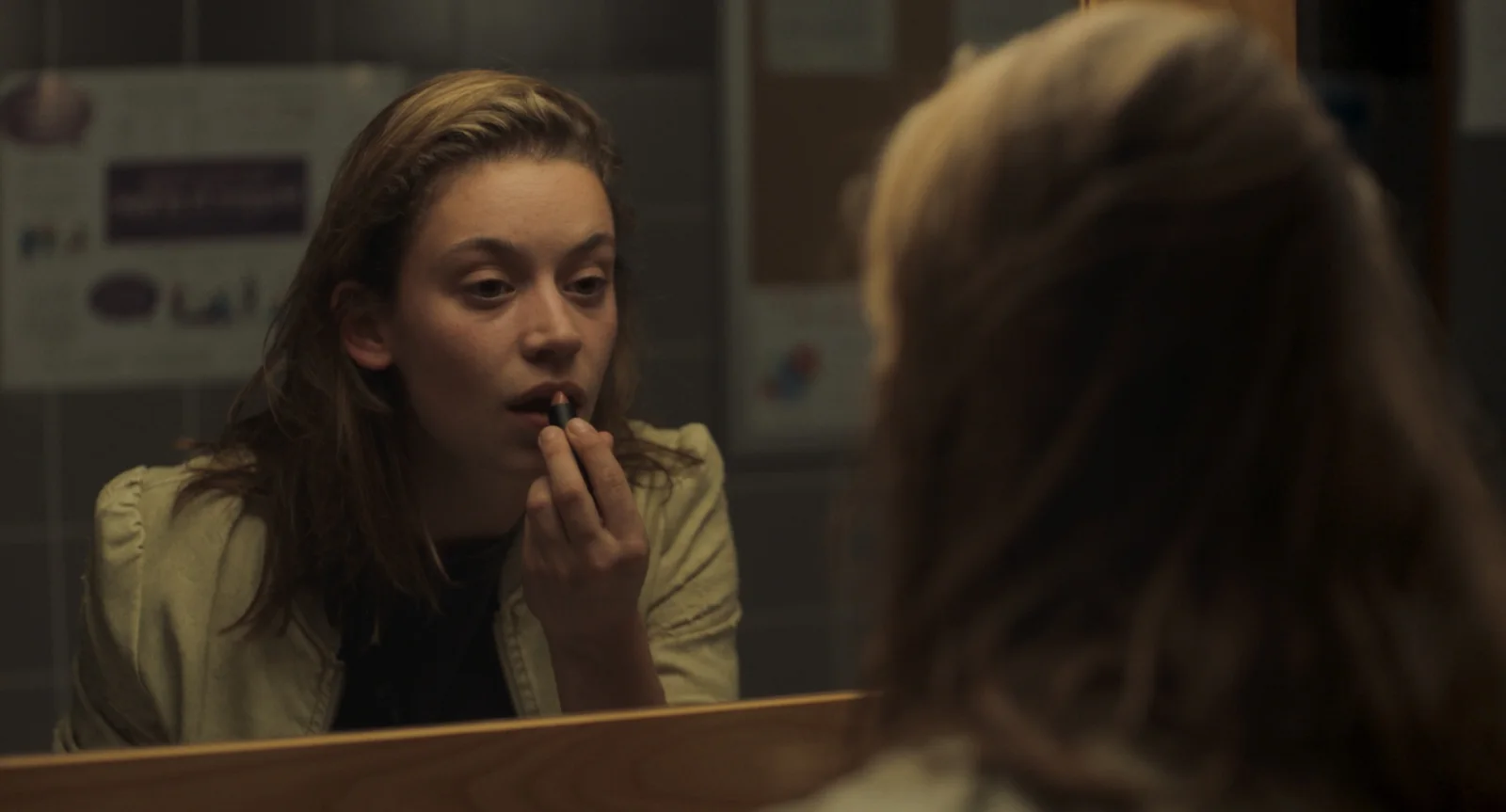
Most striking, however, is the film’s use of focus. Alexia remains sharply defined, as if clinging to a stable sense of reality, while the world around her dissolves into blur, uncertainty, and fragmentation.
This is not an aesthetic flourish, it is a philosophy of perception. A way of suggesting that clarity of vision does not guarantee clarity of understanding.
In this respect, the film stands in sharp contrast to more overtly narrative and spectacular depictions of psychiatric institutions, such as One Flew Over the Cuckoo’s Nest by Miloš Forman. Where Forman constructs a powerful dramatic architecture anchored in conflict, opposition, and character-driven momentum, On the edge withdraws from narrative as its primary engine.
It no longer stages confrontation; it sustains a state.
Similarly, while Unsane by Steven Soderbergh explores psychiatric space through paranoia and narrative manipulation, playing with the viewer’s uncertainty between delusion and reality, this film refuses such mechanisms entirely.
It does not seek to deceive, it seeks to immerse.
Between Soderbergh and Mungiu
At the opposite end of the spectrum lies 4 Months, 3 Weeks and 2 Days by Cristian Mungiu, whose influence resonates more quietly yet more deeply.
Here, one finds the same austerity, the same attention to gesture, the same ability to generate tension from the most ordinary situations. The long take becomes not a stylistic signature but an ethical position.
In Mara Taquin’s performance, there is something of Anamaria Marinca’s precision, a restraint that refuses emphasis, allowing emotion to emerge without ever insisting upon it.
And yet, the film ultimately belongs to another lineage: that of the Dardenne brothers, whose cinema confronts reality not through commentary but through direct exposure to its raw, unfiltered textures.
Empathy as Vertigo
What lingers, long after the film ends, is not a narrative but a sensation.
A slow-building vertigo, born not of plot complexity but of emotional involvement.
Like Alexia, the viewer begins to lean forward, wanting to understand, to help, to close the distance that should perhaps remain intact.
The film never tells us whether this impulse is right or dangerous.
It simply places us within it.
A Cinema of Exposure
By rejecting spectacle and resisting explanation, On the edge affirms a certain idea of cinema: not as a tool for clarity, but as a space of experience.
It asks us not to resolve, but to remain.
Not to understand, but to endure.
Carried by performances of remarkable precision, most notably that of Mara Taquin and Sasha Deprez , the movie ultimately suggests that seeing can no longer be separated from being affected.
Perhaps that is its most enduring gesture : to transform cinema into a place where perception itself becomes an ethical act.